
Products
Copper
Order Copper TECU®
OrderSeveral centuries ago, builders realized that metals are perfectly suited for roofing, as they excellently protect buildings from atmospheric moisture, sunlight, and cold. However, low anti-corrosion properties were always considered a major disadvantage of metal roofs. Standing seam copper roofing is free from this drawback, which significantly shortens the service life of a structure, because it does not alter its properties or appearance upon contact with water. Proof of this can be seen in ancient palaces and castles, whose roofs, covered with this noble material, are perfectly preserved and require no reconstruction even after 200–300 years.
Material Properties
Copper is an inert metal that does not undergo oxidation reactions with oxygen, and therefore does not corrode. A roof made of this material is lightweight, resistant to temperature changes, precipitation, and other adverse factors. The service life of a copper roof spans 100–200 years; however, history knows examples where it lasted much longer. The installation of a standing seam roof is performed using sheet copper manufactured in rolls with a width of 0.6 - 0.8 m and a thickness of 0.55 - 0.80 mm.
Copper is universally recognized as the best metal for roofing work. The natural aging of copper only adds greater strength and stability to the material. The natural layer of oxides (patina) that forms on copper reliably protects the metal from environmental influences. Over time, a copper roof acquires a dark brown and then a greenish tint.
The estimated service life of a standing seam copper roof is 100 years or more.
"ART Roofs" Company sells Copper TECU® produced by the world's largest concern, KM Europa Metal (KME), which specializes in the manufacturing of high-quality rolled copper, copper tape, as well as a wide range of related copper products.
Copper manufactured by KME stands out for its chemical purity meeting the European standard DIN EN 1172 (99.9%, of which 1.1% represents additives used to increase the ductility of the copper tape)
10 reasons to choose Copper TECU®:
- Copper TECU® is a 100% natural material, from the ore to the finished rolled copper product
- Copper TECU® possesses natural beauty, thanks to the changing surface color over time
- Copper TECU® guarantees 100% protection against moisture and leaks
- Copper TECU® is a completely recyclable material that is harmless to the environment
- Copper TECU® requires no maintenance or upkeep after installation
- Copper TECU® is a non-corrosive material
- Copper TECU® is a non-combustible material
- Copper TECU® is a reliable material with a long service life (over 100 years)
- Copper TECU® is easy to install and suitable for manual shaping
- Copper TECU® is a material created to fulfill the boldest ideas of architects
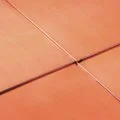
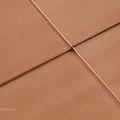

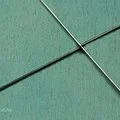
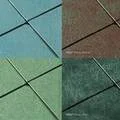


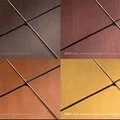

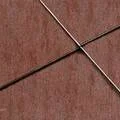

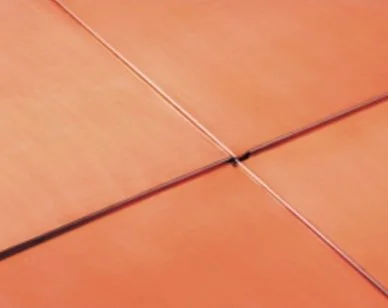
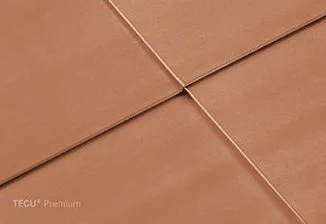
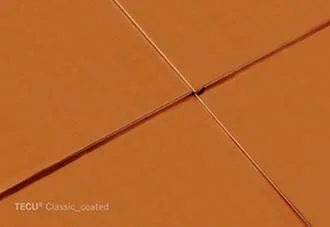
Description of Copper Surface Types:
- Classic — Copper in its classic smooth-rolled design, a true classic of copper roofing.
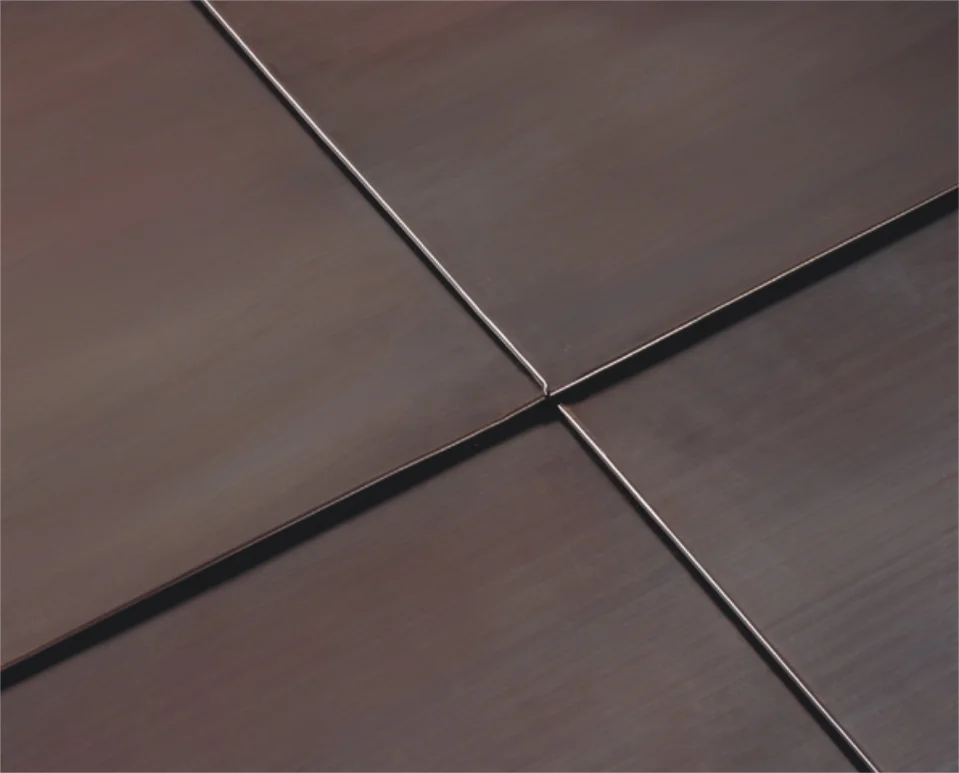
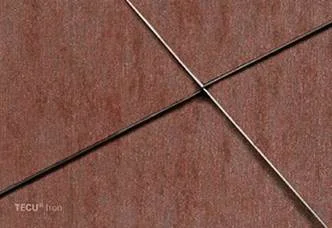
- Oxid — Copper with a neutral brown color. To achieve this surface, the copper undergoes pre-oxidation on both sides. This makes it possible to skip the initial bright stage of copper and obtain material covered with a dark brown oxide layer right at the time of installation. Importantly, the coloration is created naturally from the copper itself, rather than artificially. This means that such copper will continue to change its color under environmental influences.
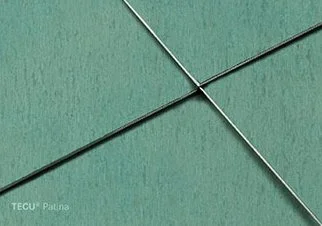
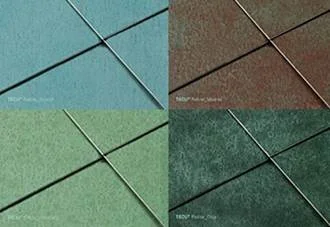
- Patina — Copper with a green color. The oxide layer, developed from the copper itself, is completely identical to the patina that naturally forms on copper only over a long period of time. The copper is patinated on one side only.
- Zinn — Tinned copper with a silver-grey color. The warm matte-grey tone harmonizes with many materials. The copper strips are tinned on both sides. This surface changes over time, becoming more matte and dark.
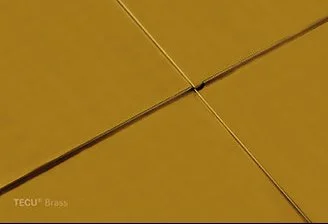
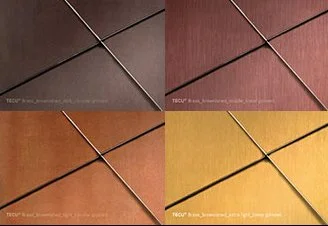
- Brass — This is an alloy of copper and zinc (CuZn15) with a brass-yellow color, used primarily for facades. The initial reddish-gold tone of the surface changes its appearance under the influence of natural aging. After initial matting, a green-brown color appears, which later gradually becomes grey-brown, and then a dark brown-anthracite. Over time, the patina familiar from classic copper forms on sloped surfaces.
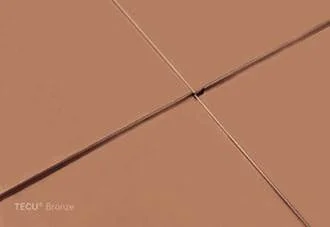
- Bronze — This is an alloy of copper and tin (CuSn4) with a reddish-brown color. Typical for this alloy is a brown-red surface oxidation combined with a brown-grey color of the base material. Gradually, the material darkens throughout its structure to a dark brown-anthracite color. Over time, the patina known from classic copper forms on sloped surfaces, offering a distinctive appearance. Compared to classic copper, the oxidation process progresses much more slowly. Bronze features exceptionally high mechanical wear resistance, supreme corrosion resistance, durability, as well as excellent strength and rigidity.
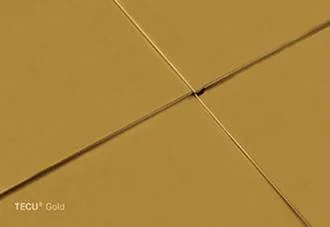
- Gold — This is an alloy of copper and aluminum (CuAl5) with a noble golden surface. The initial golden tone of the surface remains golden even under the influence of natural aging. After initial matting, a yellow oxide color appears, which later gradually develops into a bright, matte, and long-lasting golden shade. No further color change with patina formation occurs. Gold features extremely high mechanical wear resistance, corrosion resistance, durability, as well as outstanding strength and stiffness.